Thermal Break
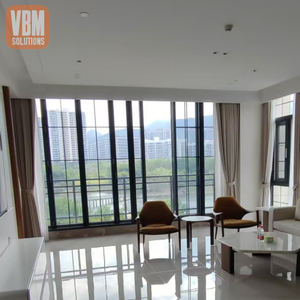
Residential Exterior Aluminum Concertina Doors Double Glass Folding Patio Door for Balcony
- Alloy Grade: 6063-T6 Extrusion
- Glazing: 5mm+12A+5mm Double Low-E
- Seal Rating: EPDM Co-Extruded
Explore high-performance residential entry portals, commercial storefront hinged doors, and thermal-break folding patio systems designed to ASTM, CE, and AS2047 fenestration standards.
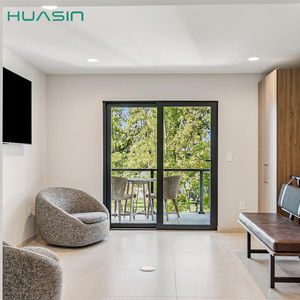
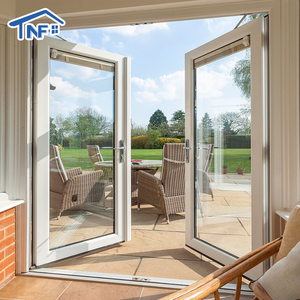
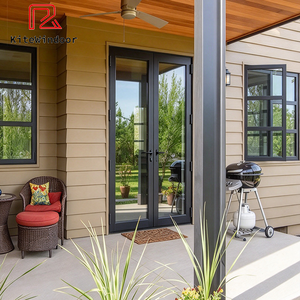
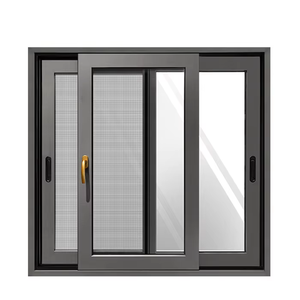
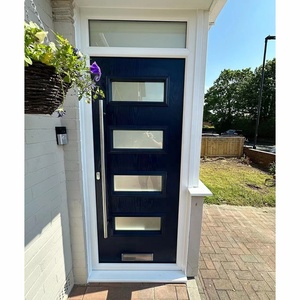
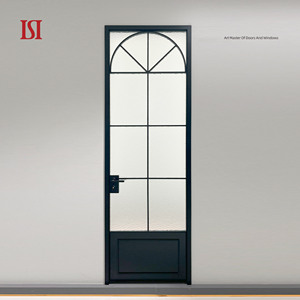
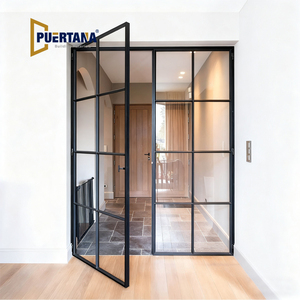
Comparing alloy compositions, polyamide thermal barriers, surface treatments, and wind load thresholds across international export grades.
When international procurement officers, facade consultants, and general contractors source aluminum front doors from Chinese manufacturing centers, differentiating between entry-level residential profiles and commercial architectural-grade fenestration requires scrutinizing raw material integrity, structural thermal break integration, and multi-point locking resilience. The frontline barrier of any building envelope—the primary entrance portal—endures continuous dynamic cycles, high wind-pressure loads, ultraviolet degradation, and forced-entry vectors.
Guangdong Dejiyoupin Doors and Windows Co., Ltd. (operating the internationally recognized DERCHI export brand) utilizes virgin primary aluminum ingot extrusions conforming strictly to GB/T 5237-2017 high-precision class and ASTM B221 standards. Unlike uncertified fabricators utilizing secondary scrap scrapings that cause micro-fissures and poor anodization uniformity, high-tensile 6063-T6 and 6060-T66 aluminum alloys guarantee high strength-to-weight ratios, ensuring door leaves exceeding 3.0 meters in height maintain planar deflection limits under ≤ L/250.
Door stile wall thickness must never fall below 2.0mm to 3.0mm for exterior entrance structures. Thin 1.2mm–1.4mm domestic window extrusions frequently offered as budget doors fail under corner-joint torque tests, resulting in latch misalignment, sash sagging, and degraded perimeter air-tightness within 18 months of installation.
| Engineering Parameter | DERCHI Commercial Export Grade | Standard Commodity Door | Applicable Testing Standard |
|---|---|---|---|
| Alloy Metallurgy | Primary 6063-T6 / 6060-T66 Ingot Zero Recycled Content | Secondary / Remelted Mixed Alloy | ASTM B221 / EN 573-3 |
| Thermal Barrier Core | Polyamide PA66 GF25 (24mm - 34mm Technoform) | PVC Strip or Poured Resin | DIN 16941 / ISO 10077-2 |
| Overall Thermal Transmittance | U-factor: 0.95 – 1.4 W/m²·K (Passive Capable) | U-factor: 2.8 – 4.2 W/m²·K | NFRC 100/200 & ISO 12567-1 |
| Anti-Intrusion Hardware | Patented Four-Side Six-Point Locking | Single-point deadbolt or 3-point latch | EN 1627-1630 (RC2 / RC3) |
| Surface Protective Coating | Qualicoat Class 2 / AkzoNobel PVDF ≥40μm | Standard Industrial Spray <20μm | AAMA 2604 / AAMA 2605 |
| Weather Sealing Gaskets | EPDM Continuous Vulcanized / Magnetic Seal | Thermoplastic TPE / PVC | ASTM C864 / BS 7412 |
Aluminum exhibits an intrinsic thermal conductivity of approximately 205 W/m·K. To comply with rigorous regional energy standards such as Title 24 (California), the Energy Star Program, and the European Union EPBD directive, thermal break architecture is indispensable. We incorporate dual extruded PA66 GF25 (polyamide reinforced with 25% structural glass fiber) struts. This material mirrors the thermal expansion coefficient of aluminum (2.4 × 10⁻⁵ /K), preventing structural separation, shear rupture, or profile delamination during severe thermal cycling between -35°C Andean alpine nights and +45°C desert direct insolation.
Macro shifts driving international buyer intent: carbon-neutral aluminum processing, oversized architectural pivots, smart ecosystem interoperability, and extreme weather resilience.
With the enactment of the EU Carbon Border Adjustment Mechanism (CBAM) and strict global ESG reporting, institutional project owners are mandating cradle-to-gate Environmental Product Declarations (EPDs). Future procurement prioritizes extrusions smelted using renewable hydroelectricity, drastically reducing embodied carbon from 16kg CO₂e/kg to under 4kg CO₂e/kg of finished aluminum frame.
Architectural trends demand monumental opening dimensions—single leaf doors reaching up to 2.2 meters in width and 4.0 meters in clearance height. Concealed self-closing hydraulic floor pivots with adjustable 90° hold-open damping systems, capable of bearing panel payloads in excess of 500 kilograms with silent, featherlight operation, are replacing conventional exposed butt hinges in luxury developments.
Mechanical brass keys are rapidly being relegated to backup emergency status. Modern institutional specifications integrate electromechanical concealed multipoint mortise locks paired with biometric fingerprint scanning, 3D facial recognition, RFID credentials, and Matter/Zigbee/Apple HomeKit protocols, enabling automated building management system (BMS) access auditing and remote management.
Climatic turbulence and rising sea levels demand doors that survive severe cyclonic storm surges and airborne missile impacts. Front entrance systems engineered for coastal regions are tested rigorously to ASTM E1886/E1996 and Miami-Dade TAS 201/202/203 criteria, combining heavy-wall extrusion jambs with SentryGlas® (SG) ionoplast laminated composite impact safety glazing.
Operating from Foshan, China—the epicenter of global aluminum innovation—delivering zero-defect fenestration across six continents.
Guangdong Dejiyoupin Doors and Windows Co., Ltd. operates a sprawling 180,000 square meter intelligent manufacturing plant in Foshan, Guangdong. Recognized officially by China's national news authority, Xinhua News Agency, as a "China Famous Brand", our enterprise combines fully automated CNC multi-axis profile milling centers, automated glass curing lines, and digital coordinate inspection systems.
With an annual delivery capability surpassing 1,000,000 square meters of architectural systems and over 18,000 completed landmark projects worldwide—including trusted installations for luxury hotel chains like Hilton Hotels and Atour Hotels—we provide end-to-end assurance from raw billet QA to sea-worthy crate stowing.
Critical technical clarifications covering containerized freight moisture mitigation, fabrication tolerances, corner joint mechanics, and certification validation.
Submit your door schedule, elevation drawings (DWG/PDF), or project specifications. Our facade engineering team will deliver a comprehensive project proposal complete with U-value thermal analysis, structural wind-load calculations, and landed CIF shipping estimates within 24 hours.