Technical Knowledge Base Frequently Asked Questions by Global Buyers & Engineers
Critical solutions to real procurement obstacles, hinge loading mechanics, water tightness calculations, and export freight management.
What structural profile wall thickness is recommended for commercial vs. residential aluminum swing doors?
For standard residential interior or light exterior applications, a profile wall thickness of 1.4 mm to 1.6 mm is typical. However, for high-traffic commercial entries, high-wind coastal installations, or heavy double-glazed units exceeding 2.4 meters in height, Guangdong Dejiyoupin Doors and Windows Co., Ltd. specifies 6063-T5/T6 architectural aluminum alloy with a nominal wall thickness of 2.0 mm to 3.0 mm. This guarantees structural rigidity against racking, wind deflection, and cyclic mechanical strain.
How do polyamide thermal break systems prevent condensation and reduce U-values in aluminum swing doors?
Aluminum is a natural thermal conductor. Without insulation, exterior heat or cold transfers directly to interior spaces. Our thermal break swing doors utilize precision-extruded PA66 GF25 (polyamide reinforced with 25% glass fiber) thermal barrier strips between the interior and exterior aluminum profiles. This discontinuous thermal bridge dramatically reduces thermal conductivity, lowering overall door U-factors to between 1.4 and 1.8 W/m²K depending on the insulated glass package, effectively eliminating internal condensation even in harsh Andean cold or high-humidity tropical microclimates.
What hardware and hinge configurations ensure zero sash sag on oversized double swing doors?
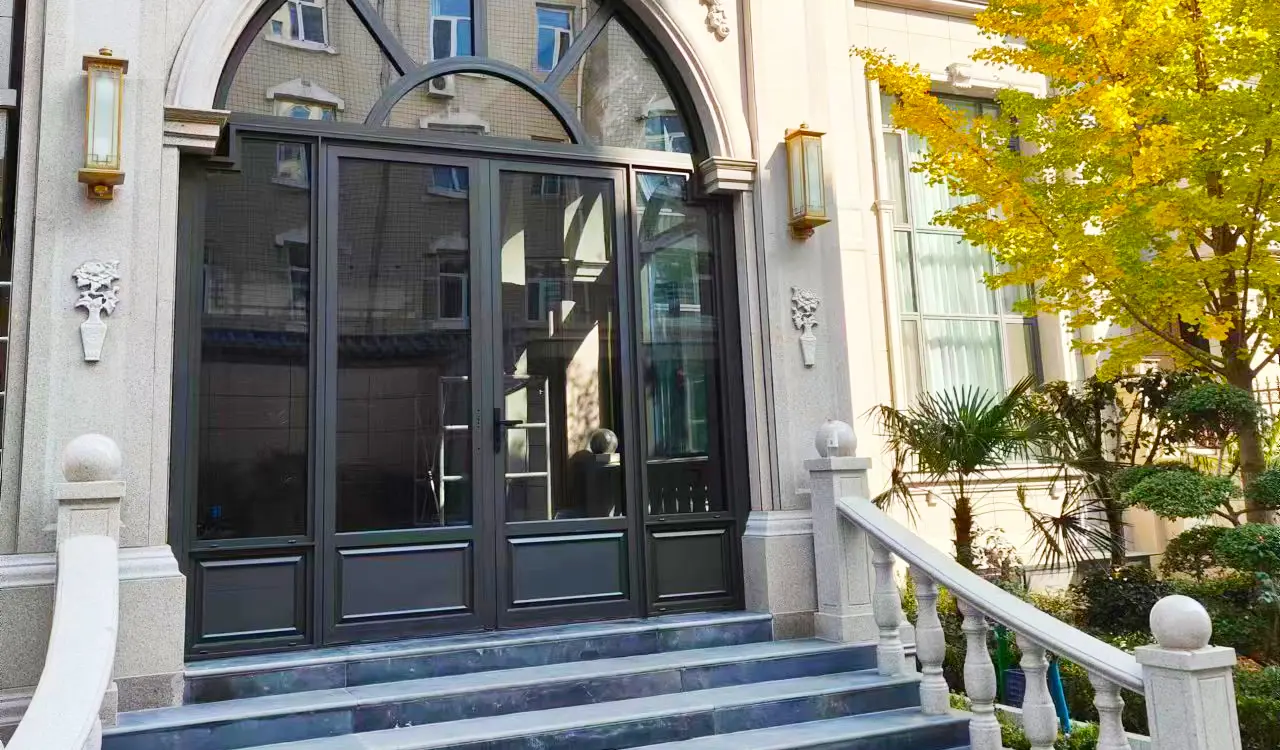
Sash sagging is the leading operational failure in wide or tall hinged aluminum swing doors. We resolve this by integrating 3D-adjustable heavy-duty barrel hinges or hidden concealed pivot systems engineered from stainless steel 304/316, load-rated up to 200 kg per panel. Additionally, glass panes are structurally installed using the "heel-and-toe" blocking technique with high-shore elastomeric setting blocks, transferring the glass deadweight directly into the hinge jamb.
How does Guangdong Dejiyoupin Doors and Windows Co., Ltd. ensure airtight and water-tight sealing on exterior swing doors?
We deploy a continuous triple-barrier EPDM gasket perimeter sealing system coupled with vulcanized corner pieces. Unlike cut-and-butt vinyl seals that shrink and pull away over time, co-extruded EPDM maintains permanent elasticity from -40°C to +120°C. For the bottom sill, we incorporate low-profile ADA-compliant thermal break thresholds with concealed weep channels and auto-drop sweep gaskets, achieving water penetration resistance over 450 Pa under cyclic wind-driven rain testing.
What international certifications validate the compliance of your aluminum swing doors for export?
Our door and window engineering systems are rigorously evaluated and certified under CE (EN 14351-1) for the European Union, NFRC and Energy Star for North American thermal compliance, AS2047 and AS/NZS 1170 for wind load and water resistance in Oceania, and CSA benchmarks. Our manufacturing facility strictly adheres to ISO 9001 certified quality management protocols, backed by more than 100 invention and utility patents.
What are the lead times and shipping packaging specifications for oceanic container freight?
Standard engineered custom production cycles span 30 to 45 business days upon shop drawing approval. For sea freight logistics, every swing door sash and pre-hung outer frame is wrapped in anti-scratch protective PE film, corner-protected with high-density EVA shock bumpers, sealed in moisture-barrier wrap, and crated in fumigated non-coniferous plywood crates reinforced with steel banding, engineered specifically to resist oceanic salt humidity and rough handling.