Direct Factory Collection
Engineered Fenestration & Louvre Systems
Precision architectural envelopes fabricated at our 180,000 m² Foshan production facility, tested rigorously under international load and cycle conditions.
25+
Years Engineering Expertise
180,000m²
Industrial Production Footprint
18,000+
Global Landmark Deliveries
100+
National Engineering Patents
Engineering Authority & System Selection
Architectural Aluminium Louvre Windows: Product Matrix & Structural Applications
Modern architectural louvre systems are no longer basic ventilation slats. In contemporary commercial, hospitality, and coastal residential architecture, aluminium louvres act as sophisticated aerodynamic filters that regulate natural airflow, prevent rainwater penetration, mitigate solar radiant load, and maintain structural envelope integrity during hurricane conditions.
Thermal-Break Aerodynamic Louvres
Configured with multi-chamber extruded 6063-T6 or 6061-T6 architectural aluminium alloys and interrupted by high-density polyamide (PA66 GF25) insulating struts. These units effectively halt conductive thermal transmission across tropical high-ambient and cold Andean microclimates, achieving thermal transfer coefficient (U-value) reductions down to 1.6 W/m²·K.
Hurricane-Impact & Acoustic Blades
Engineered specifically for coastal cyclone routes and dense urban corridors. Incorporates hollow acoustic chamber profiles injected with closed-cell damping materials or structural laminated glass louvre blades compliant with ASTM E1886/E1996 Large Missile Impact protocols and AS2047 cyclonic loading standards up to 4500 Pa positive/negative design pressures.
Dual-Motion Motorized Climatic Louvres
Integrated linear actuators and central Building Management System (BMS) connectivity operating via RS485 or KNX protocols. Blades pivot precisely between 0° and 135° based on dynamic sun tracking and wind-rain sensory inputs, delivering optimum passive indoor thermal comfort and verified solar heat gain coefficient (SHGC) minimization.
Global Market Forecasting
Future Procurement Trends in Architectural Fenestration (2025–2030)
Procurement officers, international facade consultants, and general contractors are adapting to stricter zero-carbon building directives, supply chain traceability requirements, and regional climate volatility. Forward-thinking procurement strategies now emphasize four pivotal market shifts:
Low-Carbon Primary Alloys
Global mandates (such as the EU Carbon Border Adjustment Mechanism) are driving commercial developers to source louvre systems fabricated from hydro-powered or scrap-recycled green aluminium billet, requiring verified third-party Environmental Product Declarations (EPD).
PVDF Hyper-Durable Surface Coats
Demand is accelerating for ultra-thick (≥60μm) fluoropolymer electro-sprayed finishes (AAMA 2605 compliant) capable of withstanding 4,000+ hours of continuous salt spray test exposure in Pacific and Atlantic maritime zones without blistering or chalking.
Modular Sub-Frame Integration
To reduce high on-site labor overhead in target export destinations, specifiers are demanding factory-pre-assembled sub-frames with integrated sill flashings, seismic compensating brackets, and plug-and-play blind installations straight from the container.
Digital Twin & BIM Delivery
Top-tier procurement pipelines now mandate full Level 2 BIM integration (Revit/IFC formats) along with mechanical shop drawings before production sign-off, ensuring collision detection against HVAC ducting and structural slab perimeters.
Engineering Technology Roadmap
Technological Milestones Shaping Louvre Envelope Performance
The technological progression of China's premier aluminium louvre windows reflects advances in precision extrusion, seal polymer science, and mechanical transmission design:
1. Continuous Co-Extruded EPDM & Santoprene Gasket Seals
Traditional felt-pile weatherstripping exhibits rapid atmospheric degradation when subjected to intense tropical UV indices and saline air. Contemporary engineering integrates peroxide-cured vulcanized EPDM or Santoprene micro-cellular bulb gaskets directly within the extruded interlocking blade profiles. Under wind pressure, these gaskets utilize positive pressure-energized compression, attaining absolute water penetration resistance under dynamic testing up to 700 Pa (equivalent to storm winds of over 120 km/h) according to EN 12208 Class 9A.
2. Heavy-Duty Dual-Side Mechanical Linkage & Hidden Pivot Pins
Historical louvre window failures commonly stem from blade sag, plastic clip fatigue, and unilateral drive imbalance. Advanced manufacturing employs precision CNC-milled 304 or 316 marine-grade stainless steel internal linkage bars concealable within the side jambs. Dual-side synchronized drive pins eliminate torsion deflection on extra-wide spans (up to 1,500 mm individual blade width), enabling effortless manual handle rotation or whisper-quiet 24V DC brushless motor operation with over 50,000 continuous open-close duty cycles.
3. Integrated Security Barrier Blades with Patented Multi-Point Interlocks
Balancing continuous ambient ventilation with forced-entry defense has traditionally posed a design compromise. Modern louvre systems address this through high-tensile hollow extruded core blades capable of receiving continuous hardened internal steel bars, combined with our proprietary Four-Side Six-Point locking transmission. This architecture delivers verified anti-intruder protection compliant with RC2/RC3 European security norms while facilitating 85% unimpeded aerodynamic free area.
4. Self-Cleaning Super-Hydrophobic Nanocoatings
Accumulated industrial particulates and marine salt crusting severely degrade facade aesthetics and mechanical pivot lifespan. The deployment of polysilazane-based photocatalytic nanocoatings on louvre surfaces induces super-hydrophilic water sheeting during precipitation. This chemical surface tension mechanism naturally washes away particulate sediment without abrasive manual washing, reducing facade life-cycle maintenance costs by more than 40% across commercial high-rises.
Manufacturing Might & Quality Control
Guangdong Dejiyoupin: Zero-Error Precision at Scale
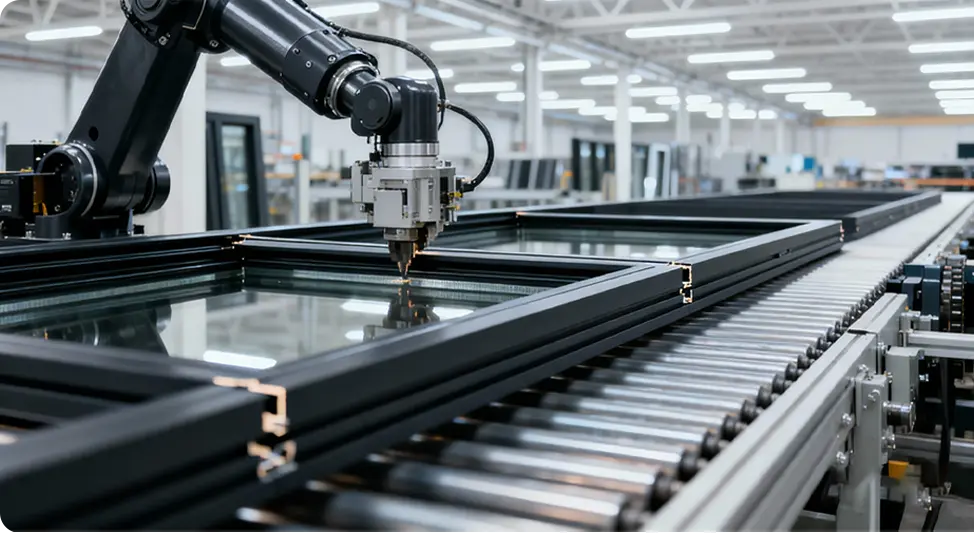
Headquartered in the heart of China's aluminum industrial capital—Foshan, Guangdong—Guangdong Dejiyoupin Doors and Windows Co., Ltd. (DERCHI) operates an advanced 180,000 m² smart manufacturing campus. We bridge the gap between heavy industrial capacity and hyper-precise project customization.
Recognized as a "China Famous Brand" by the world-class Xinhua News Agency and backed by over 100 independent engineering patents, our automated CNC processing lines and 360° total quality management regime guarantee that every extruded profile, mullion intersection, and hardware assembly arrives at your job site ready for exact fitment without field modification.
ISO 9001 Certified
CE Conformity (EU)
NFRC Rated (USA)
AS2047 Compliant (AU)
CSA Certified (Canada)
Energy Star Rated
Four-Side Six-Point Lock Patent
Engineered Precision Protocol
Our Systematic 8-Step Turnkey Procurement Process
We take complete accountability for your architectural envelope from initial concept drawings to international port delivery and on-site assembly guidance.
01. Drawing Review
Thorough CAD/BIM structural review of your schedules, structural deflections, and wall interface details.
02. R&D Engineering
Selecting custom alloys, thermal break profiles, and hardware mechanisms tailored to local wind and seismic codes.
03. Technical Proposal
Issuing comprehensive calculation packages, finite element wind analysis, thermal metrics, and structural guarantees.
04. Sample & Shop Drawing
Finalizing 1:1 cross-section details, corner mockups, RAL/Pantone color match approvals, and written milestones.
05. Production Scheduling
Locking CNC production slots with synchronized ERP traceability tracking each extrusion batch.
06. Opening Verification
On-site or digital laser dimension checks ensuring zero site-adjustment during civil structural erection.
07. 360° QC & Pre-Packing
Air/water tightness chamber testing, torque checks, and multi-layer film-and-plywood seaworthy crating.
08. Installation Guidance
Full bilingual installation instruction packages, exploded 3D drawings, video walkthroughs, and engineer dispatch.
Direct Factory Q&A
Frequently Asked Questions by Global Project Specifiers
Essential technical, logistics, and compliance intelligence for project engineers, procurement managers, and real estate developers.
What international certifications validate your aluminium louvre windows and door systems? ▼
Our products undergo comprehensive independent laboratory testing to verify compliance with global fenestration performance standards. Depending on your target project destination, our assemblies conform to CE standards (EN 14351-1 for European conformity), NFRC thermal and solar rating protocols (USA), AS2047 and AS1288 structural wind-load and cyclonic water standards (Australia), CSA standards (Canada), and Energy Star criteria. Our manufacturing plants operate strictly under ISO 9001 certified quality management protocols, backed by over 100 patented structural designs including our proprietary Four-Side Six-Point locking anti-burglary system.
How do you guarantee air and water tightness on high-rise architectural louvres? ▼
To achieve stringent air permeability (EN 12207 Class 4) and water tightness (EN 12208 Class 9A or higher), our louvre profiles employ overlapping multi-baffle geometry with integrated continuous EPDM compression gaskets. Rather than relying on simple gravity closure, our system features dual-linkage internal stainless steel actuators that apply mechanical compression when closed. Additionally, our outer frames feature concealed internal weeping channels and stepped drainage cascades that divert driving rain toward exterior pressure-equalized weep holes, preventing internal head siphoning even under sustained cyclonic winds.
Can your louvre systems be engineered to resist coastal salt air corrosion? ▼
Yes. For maritime coastal developments, we specify 6063-T6 virgin architectural alloy profiles treated with marine-grade surface finishes. We offer Qualicoat Class 3 or AAMA 2605 compliant PVDF (polyvinylidene fluoride) architectural fluorocarbon coatings with minimum three-coat wet film thickness (≥40-60μm), or Class 20/25 architectural anodic oxidation (20-25μm thickness). All mechanical pins, gear transmissions, and screws are strictly grade 304 or 316 stainless steel, backed by over 4,000 hours of continuous neutral salt spray (ASTM B117) and cyclic corrosion verification.
What is the standard production cycle and global ocean freight transit timeline? ▼
Production lead times generally range between 30 to 45 business days following final architectural shop drawing sign-off and engineering deposit clearance. Custom dies or non-standard architectural color matching require an additional 7 to 10 days for metallurgical extrusion validation. Ocean freight transit depends on your destination port: major West Coast USA/Canada ports typically take 14 to 22 days; European main ports take 28 to 35 days; while Latin American gateways (such as Santos, Buenos Aires, San Antonio, Callao, or Guayaquil) require 30 to 50 days. Every container is loaded with precise weight/volume optimization and reinforced export pallet crating.
Can you customize acoustic louvre assemblies for hotel and high-density residential towers? ▼
Yes. We have provided acoustic envelope solutions to world-renowned hospitality brands including Hilton Hotels and Atour Hotels. Our acoustic louvres incorporate engineered aero-acoustic profile chambers lined with sound-absorbing micro-perforated baffles and high-density mineral wool or specialized visco-elastic damping membranes. This setup delivers weighted sound reduction indices (Rw) between 28 dB to 42 dB while maintaining required passive air changes per hour (ACH) for mechanical plant rooms or luxury guest quarters.
How are crated products protected against maritime transit damage and rough handling? ▼
Every louvre window and door panel is wrapped in protective, peelable low-tack protective film, equipped with reinforced heavy-duty edge corner guards, and enclosed in waterproof thermal-shrink film. Assemblies are then mounted into fully-fumigated, moisture-sealed plywood crates fitted with internal bracing beams and rubber cushioning blocks. Every crate features exterior color-coded project labelling, floor-by-floor scheduling tags, and tip-and-tilt shock indicators, simplifying on-site laydown and vertical logistics.
Accelerate Your Fenestration Project with Our Engineering Team
Submit your architectural drawings, window schedules, or custom structural specifications. Our senior facade engineering department will deliver verified static calculations, thermal simulation reports, and detailed factory-direct quotation within 24 business hours.