EN 12207 / EN 12208 Compliance & Architectural Grade
CE Certified Aluminium Louvre Doors Manufacturers & Suppliers
Precision-engineered thermal break, acoustic-damped, and hurricane-rated ventilation louvre door systems tailored for multi-climate global building envelopes.
Engineered Portfolio
Featured Commercial & Residential Architectural Systems
Explore our export-certified aluminum fenestration and engineered louvered structural systems, built according to rigid CE, AS2047, and NFRC benchmarks.
Decoding the Engineering of CE Certified Aluminium Louvre Doors
Architectural aluminum louvre doors represent a delicate equilibrium between free ventilation area (FVA), acoustic insulation, structural deflection limits, and precipitation ingress defense. For tier-1 commercial developments, industrial infrastructure, and coastal luxury residential villas, specifying CE-marked systems guarantees audited reliability under EN 14351-1 and related European standards.
Aerodynamic Profiles & Free Area (FVA)
Traditional louvre assemblies often compromise structural integrity for airflow. CE certified engineered louvre assemblies utilize precision-extruded 6063-T6 or 6060-T6 alloy blades mathematically curved to create a dual-pressure baffle. This optimizes discharge coefficients (Cd) while preventing vortex whistle, achieving airflow efficiencies surpassing 52% free area without sacrificing weatherproofing.
Dynamic Precipitation & Water Ingress Defense
Testing according to EN 13030 defines how louvres perform when wind-driven rain attacks at velocities up to 13 m/s. Our patented multi-stage cascade drain louvre doors incorporate internally routed concealed water drains and hydrophobic EPDM dual-lip seals, channeling moisture directly downward to exterior weep tracks before dynamic indoor pressure pulls water past the blade crest.
Acoustic Attenuation & Thermal Barrier Break
To eliminate the thermal bridging endemic to metallic vents, commercial-grade louvered systems utilize polyamide (PA66 GF25) thermal strut isolators. In noise-critical mechanical rooms, hospital HVAC penetrations, or luxury hotel generator enclosures, integrated acoustic louvre blades packed with mineral fiber and covered by micro-perforated facing provide significant Rw transmission reductions.
Performance Attribute
Standard Conventional Louvre
CE Certified Architectural Break Louvre
DERCHI Patented Heavy-Duty System
Aerodynamic Airflow (FVA)
30% - 38%
45% - 50%
52% - 61% Optimized Coefficient
Water Tightness (EN 12208)
Class 1A (Zero resistance to wind-driven spray)
Class 4A - 6A (Standard Baffled)
Class 9A / E1050 Extreme Cascade Drain
Structural Deflection (EN 12210)
Class B2 (Risk of blade flutter)
Class C3 (Commercial Standard)
Class C5 / Hurricane Impact NOA Rated
Hardware & Intrusion Defense
Single-point slide latch
Standard 3-point deadbolt
Patented Four-Side Six-Point Anti-Theft Lock
Corrosion Resistance (Salt Spray)
Standard Mill or thin powder (240 hrs)
Qualicoat Class 1 (480 hrs)
Qualicoat Marine / PVDF Anodized (1500+ hrs)
Procurement Strategy
Future Sourcing Trends for Aluminium Louvre Fenestration
As international green building codes, embodied carbon mandates, and climate resilience reshape specifications, procurement officers and structural engineers must evaluate dynamic criteria to avoid structural non-compliance and cost overruns.
1. Transition to Circular, Low-Carbon Smelted Alloys
Global architectural standards (LEED v4.1, BREEAM, and EU Green Taxonomy) increasingly mandate verified Environmental Product Declarations (EPDs). Future aluminium louvre procurement will favor suppliers integrating scrap closed-loop recycling and hydroelectric-smelted primary billets with embodied carbon emissions below 4.0 kg CO2e/kg Al.
2. Motorized BMS-Integrated Active Aerodynamics
Static louvres are giving ground to smart dynamic facades. Driven by 24V DC micro-actuators synced with building management systems (BMS), intelligent louvre blades articulate automatically based on interior air quality (CO2/VOC), external wind velocities, and ambient temperature, optimizing passive cooling cycles while maintaining watertight security.
3. Prefabricated Structural Unitization
Site labor costs across North America, Europe, and Australasia are forcing a rapid migration toward factory-glazed, fully unitized plug-and-play louvre casements. Pre-calibrated sub-frame fixing anchors, snap-lock mullion attachments, and pre-fitted EPDM perimeters reduce onsite installation windows by up to 65% compared to stick-built field assemblies.
Why Partner With DERCHI
Industrial Capacity Rooted in Precision, Patents, and Scale
Manufactured by Guangdong Dejiyoupin Doors and Windows Co., Ltd. within our massive 180,000 m² industrial hub in Foshan, our infrastructure is built to de-risk high-stakes architectural contracts worldwide.
100+ National Patents & Locking Inventions
Equipped with specialized R&D laboratories, our proprietary intellectual property includes the groundbreaking Four-Side Six-Point perimeter anti-theft locking system, engineered to repel brute-force forced entry while ensuring continuous acoustic compression along the door frame perimeter.
Multi-Jurisdiction Worldwide Certification
Unlike regional suppliers, our systems carry authenticated certifications across major global jurisdictions: CE (European Union EN 14351-1), NFRC (USA energy ratings), AS2047 & AS1288 (Australia), CSA (Canada), and Energy Star, backed by rigorous ISO 9001 quality process controls.
Xinhua "China Famous Brand" Media Recognition
Our commitment to engineering integrity has earned national spotlight recognition from Xinhua News Agency. From our high-precision CNC multi-axis milling benches to automated corner-crimping equipment, each door is tracked through a 360-degree quality audit before crating.
Proven Across 18,000+ Completed Projects
Our systems defend high-profile developments globally, serving prestigious hospitality chains such as Hilton and Atour Hotels, luxury hillside private estates in Beverly Hills, high-density residential towers in Santiago and Sao Paulo, and harsh desert environments across the Middle East.
Tailored Seismic & Climate Adaptation
Whether navigating the active seismic fault zones of Chile and Peru with flexible structural anchors, or warding off salt-spray corrosion on Atlantic Caribbean coastlines with marine-grade 25-micron anodization or fluorocarbon treatments, our engineering department formulates site-matched project submittals.
End-to-End Technical Delivery Chain
From CAD/BIM shop drawing development, finite element wind deflection calculations, and factory pre-assembly testing to custom sea-freight steel-reinforced crating and remote or on-site engineering installation guidance, we ensure your site handover achieves a zero-error tolerance.
Knowledge Base
Frequently Asked Questions on Aluminium Louvre Procurement
Direct technical answers addressing engineering standards, logistical timelines, material specifications, and quality verification for international specifiers.
What specific test reports validate that an aluminium louvre door is CE certified?
CE marking for external pedestrian doorsets and louvered envelope openings is governed by harmonized European standard EN 14351-1. To legitimately display the CE mark, the manufacturer must provide a Declaration of Performance (DoP) supported by third-party laboratory test credentials verifying: air permeability under EN 12207, water tightness under wind pressure via EN 12208, wind load structural resistance according to EN 12210, and mechanical durability (repetitive opening and closing cycles) in accordance with EN 1191. DERCHI units maintain exhaustive documentation dossiers ready for customs clearance and municipal building authority audits.
How does an engineered louvre prevent rainwater infiltration during coastal storms?
Standard generic vents rely on angled single blades, which fail as soon as external winds exceed 8-10 m/s, blowing water upward over the rear edge. Our CE certified architectural louvre door systems feature a compound double or triple aerodynamic baffle geometry. As driving rain enters the blade zone, momentum forces water droplets against forward catch-lips that drop the liquid into concealed vertical internal drain channels. The water is evacuated gravity-free via bottom sill weeping chambers equipped with one-way backflow flappers, preventing wind pressure from blowing discharge back inside the structure.
Can your louvre systems be combined with insect protection, acoustic dampening, or solid infill panels?
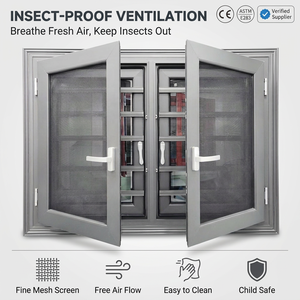
Yes. Our modular profile extrusions permit multi-layer hybrid configurations within a single leaf casement. Options include internal marine-grade 304 or 316 stainless steel high-flow insect screens, security woven mesh, rear bird guards, or dual-stage acoustic mineral wool sound baffles. Furthermore, we regularly supply split designs featuring high-security insulated solid aluminium lower kick-panels with aerodynamically louvered upper sections for utility rooms, substations, and residential utility enclosures.
What surface treatments ensure that aluminum louvre doors resist coastal marine salt corrosion?
For marine atmospheres (ISO 12944 Corrosivity Categories C4 and C5-M), standard commercial powder coatings will blister and peel from filiform corrosion within 24 to 36 months. We recommend either deep acid-etched architectural anodizing (Class 1, minimum 20-25 micron oxide depth) or multi-coat electrostatic Polyvinylidene Fluoride (PVDF) fluorocarbon liquid finishes containing at least 70% Kynar 500 resin conforming to AAMA 2605 requirements. These coatings endure rigorous 4,000-hour continuous salt spray and prolonged high-altitude UV radiation cycles without chalking, cracking, or color shift.
What are the typical manufacturing lead times and freight protection parameters for overseas delivery?
Standard fabrication timeline ranges between 25 to 35 calendar days following client sign-off on shop CAD drawings and finish color swatches. Ocean shipment logistics add approximately 15 to 45 days depending on whether cargo is routed to European ports (Rotterdam, Hamburg, Valencia), North American gateways (Long Beach, Houston, New York), or South American hubs (Santos, Callao, Buenos Aires). All doors receive protective low-tack film wrapping, heavy-density edge cushions, and are fully secured within fumigated multi-ply timber export crates with internal moisture-absorbing desiccant packs to prevent moisture condensation during sea voyage transitions.
Ready to Engineer or Procure Certified Aluminium Louvre Systems?
Connect with our technical architectural facade specialists. We review your opening schedules, wind load demands, and aerodynamic specifications to deliver complete, optimized CAD submittals and factory-direct pricing.